The AI-Native Talent OS: Fixing the Gaps in Traditional
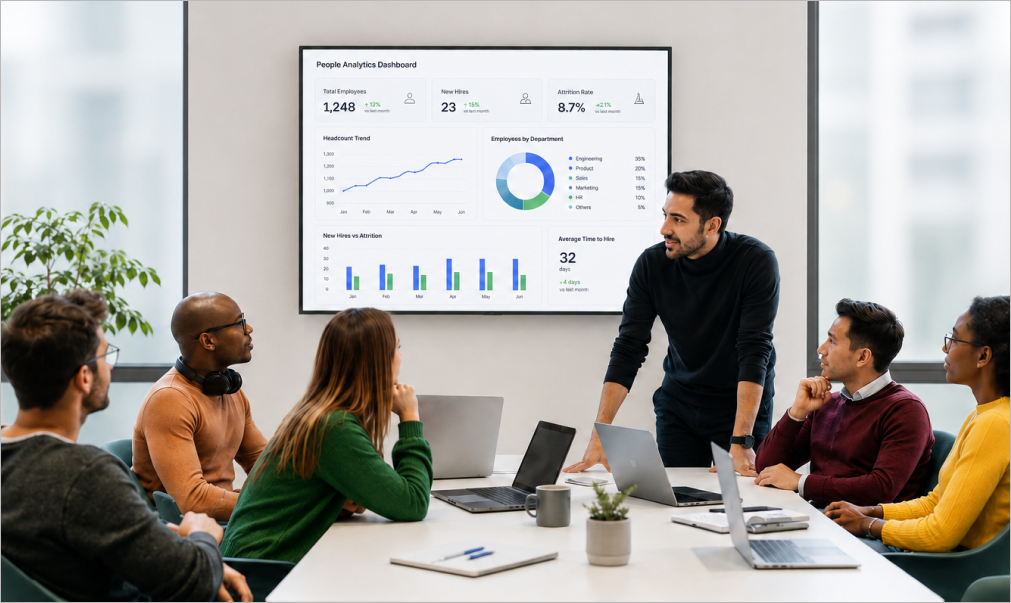
Every major enterprise running SAP SuccessFactors, Workday, or Oracle HCM has the same soundless problem. The system is full of data. Headcount records, job histories, performance ratings, learning completion logs — years of it. But ask a Chief Human Resources Officer (CHRO) where their actual workforce capability gaps are, and you will hear one of two answers: "We're pulling a report on that," or "We just started a workforce planning project."
That one structural difference changes the whole game. In a bolt-on AI model, the data resides in the HRIS, and the intelligence layer serves as a "lookout". In an AI-native Talent OS, intelligence is the foundation, and hiring, learning, performance, and career growth are built on it, all sharing the same data model in real time.
What Is a Talent Operating System (OS)?
A Talent Operating System isn’t your typical all-in-one HR platform. It is a one-vendor solution that combines HRIS, LMS and performance management in a single interface. Even with a single login, the logic remains fragmented.
A Talent OS is architecturally different. Skills are detected from real work, not self-declared. Every action, for instance, a project completed, a peer review submitted or a goal achieved, feeds into a continuous intelligence model. That intelligence flows natively across four modules:
- Acquire: Skills-based hiring matched against verified capability, not job title history.
- Learn: Development delivered in the flow of work, triggered by context, not quarterly training calendars.
- Perform: Performance signals that feed directly back into the intelligence layer.
- Grow: Career pathing and internal mobility grounded in real-time workforce intelligence.
According to the Future of Jobs Report 2025 by the Word Economic Forum (WEF), 77% of employers globally plan to upskill their workers by 2030. The intelligence infrastructure-building organizations today will carry that mandate more quickly than all those still running chopped-up stacks.
The Business Case
The WEF Future of Jobs Report 2025 identifies skill gaps as the single largest barrier to business transformation — ahead of investment capital and regulation. 4 in 5 organizations report difficulty finding candidates with the skills they need right now, according to the SHRM 2025 Talent Trends report. The organizations that close this gap do it through architecture, not effort.
Organizations that have upgraded their HR stacks into intelligent talent systems gradually are reporting:
- 75% faster hiring — sourcing time reduced by 90%, time-to-fill by 60%.
- 40% faster skill development — because learning is contextual, applied, and verified.
- Higher retention — 88% of organizations say retention is a concern, and career-driven learning with internal mobility is the top response.
According to the 2025 Global Skills Intelligence Survey by Skillsoft, 28% of HR professionals say skill gaps are directly limiting their ability to pursue new markets. Only 18% of organizations regularly measure skills throughout the talent lifecycle. The gap between knowing and acting is a data architecture problem.
The Right Question Isn't "Should We Use AI?"
Every executive team is asking some version of the AI question right now, and most of them are asking it wrong.
"Should we add AI to our HR stack?" is the wrong frame. Bolt-on AI layers atop a fragmented HRIS infrastructure produce AI-powered dashboards, not workforce intelligence. The system underneath is still a data graveyard.
The right question is, does our talent architecture produce intelligence that compounds over time? Can we answer, with confidence, not with a report request, where our capability gaps are, who is ready to move, where our highest-risk attrition is, and what our workforce will be able to do in 18 months?
If the answer is no, the problem isn't the AI layer; it’s in the foundation.
Conclusion
An AI-native Talent OS is not a new system to manage talent; it is a new way of thinking about what workforce intelligence should produce and building the architecture that makes that intelligence available to every decision that touches your people.
The organizations that win the next decade of workforce competition will not be the ones with the most headcount. They will be the ones with the clearest picture of what existing people are capable of and the intelligence infrastructure to act on it faster than everyone else.
OneGuru is an AI-native Talent Operating System built by Infopro Learning, combining Skills Intelligence, AI Workspaces, and a complete talent lifecycle platform (Acquire, Learn, Perform, Grow) into a single unified system. Connect with the team or request a free demo to see how OneGuru transforms your workforce into a competitive advantage.